The Future of Agentic Security: Exposing the Data Attack Surface to AI Agents via Model Context Protocol
- Date: Dec 29, 2025
- Read time: 4 minutes


Unstructured data has always been the ultimate target — yet it has remained the least automated security domain.
While endpoint, identity, and cloud security have evolved toward real-time detection and automated response, the data layer has historically relied on dashboards, exports, and human-driven investigation. Even modern exposure management tools stop short of enabling autonomous response where sensitive data actually lives.
That changes with Model Context Protocol (MCP).
With MCP server support in the Superna Data Fortress MCP Server, data security becomes a first-class, AI-native control plane — one that AI agents can query, reason about, and act upon in real time.
This document describes a working, cross-domain prototype where AI agents combine data attack surface intelligence, cyberstorage controls, endpoint telemetry, and user behavior to autonomously respond to threats in seconds.
The Legacy API Problem
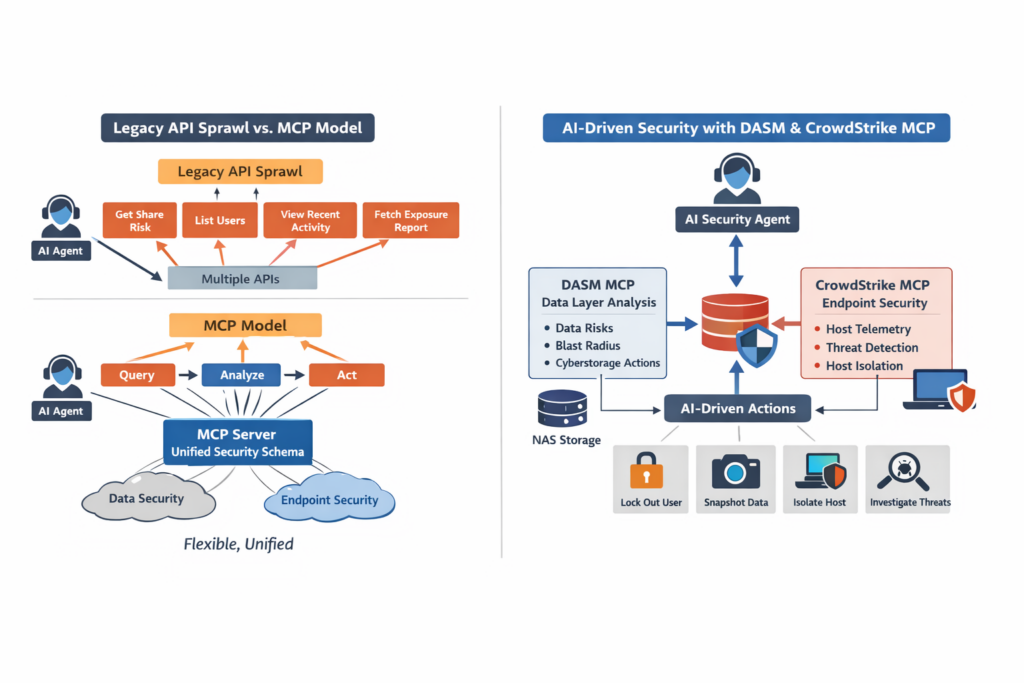
Traditional security platforms expose hundreds or thousands of APIs, each designed to answer a single predefined question. This model works for humans, but fails for AI.
Every new question requires new endpoints, documentation, and client logic. AI agents do not think in endpoints — they think in relationships, context, and inference.
MCP Inverts the Model
Expanded Technical Architecture: The Normalized Schema
The power of MCP lies in its normalized, graph-based data schema. Instead of disparate, domain-specific APIs, the agent is presented with a unified security data graph. Key entity types exposed include:
- User: Identity and behavior (risk score, last known activity)
- Endpoint: Telemetry and state (host isolation status, installed software)
- Data Object: File paths, shares, and sensitive data classification (PII count, exposure level)
- Security Event: Correlated threat detection signals across all domains
This rich context allows the AI agent to execute complex, multi-step reasoning — from identifying data exposed to high-risk users to isolating endpoints and revoking access for the user responsible for the most recent sensitive data exposure.
MCP shifts the question from “Which API do I need?” to “What data do I already have, and how can I reason over it?”
By exposing a small number of composable tools backed by rich schemas, MCP enables infinite analytical permutations from finite tools and eliminates API sprawl.
Introducing the Superna Data Fortress MCP Server
The Superna Data Fortress MCP Server is an AI-native security interface that unifies:
- Cyberstorage security (Data Security Edition)
- Data Attack Surface Management (DASM)
- Behavioral analysis
- Blast radius computation
- Active data-layer enforcement
into a single data security control plane exposed directly to AI agents.
Cyber Mesh Security Architecture
This architecture enables cyber mesh security, where MCP servers across domains expose normalized schemas to AI agents. The agent becomes the orchestration layer, combining data security, endpoint security, and identity into a single reasoning graph.
Prototype: Cross-Domain Agentic Security
This prototype connects two MCP servers simultaneously:
- Superna Data Fortress MCP Server — data security, data attack surface intelligence, cyberstorage enforcement.
- CrowdStrike Falcon MCP Server — endpoint telemetry, threat detection, and host isolation.
Together, they allow AI agents to reason across endpoints, users, and data as a unified attack surface.
Cyberstorage Actions Exposed to AI
Beyond Ransomware: High-Value Agentic Use Cases
While ransomware defense is a compelling example, cyber mesh security enables broader autonomous protection:
- Autonomous Insider Threat Mitigation: AI detects anomalous user behavior accessing sensitive data, triggers Data Fortress Lockout, and snapshots data before exfiltration completes.
- Compliance and Governance Remediation: AI continuously evaluates exposure. If regulated data is discovered with overly permissive access, permissions are automatically tightened and actions logged for compliance.
Data Fortress Lockout: Immediately disables high-risk users or service accounts.
Data Fortress Snapshot: Creates immutable snapshots of critical data paths during ransomware-like activity.
Data Fortress Blast Radius: Maps users, endpoints, shares, and paths to quantify real business impact.
Quantifying the Shift: From Hours to Seconds
The move to agentic security translates directly to measurable improvements in security operations:
- Reduction in Mean Time to Contain (MTTC): Human-driven investigation often takes hours. MCP-enabled AI agents perform cross-domain reasoning and containment in seconds, collapsing blast radius before damage spreads.
- Elimination of Investigation Lag: MCP removes the need for dashboards, exports, and manual correlation by providing real-time, queryable context directly to the AI control plane.
Real Results
Using the combined MCP servers, the AI agent identified ransomware-like behavior, sensitive data exposure, misconfigurations, and calculated blast radius across users, endpoints, and shares — enabling autonomous response in seconds.
Join the January 21, 2026 live webinar to see the Agentic Security demo.
Closing Thought
Attackers already understand that data is the objective. With the Superna Data Fortress MCP Server and cyber mesh architecture, data security becomes agent-operated, cross-domain, and autonomous by design.
The future is security and better outcomes from cyber incidents has never looked better.
Featured Resources

Mastering Cybersecurity Insurance Negotiations: A Comprehensive Guide

Navigating the Digital Menace: A Beginner’s Guide to Ransomware